For the “Design per il Digital Retail” course in my final year at Politecnico di Torino, we were tasked with envisioning a future service in the realm of tourism and travel. My group’s mission: to imagine how travel could evolve in a rapidly changing world. My primary role was to design the app, crafting all the visual elements like cards, buttons, and other key assets.

Date
July, 2023
Role
Lead UX Designer and UI Designer
Client
University Project
Exploring Tomorrow
We kicked off the project by diving deep into the concept of tourism and travel, tracing how they’ve transformed over the years and analyzing current trends. From there, we projected how these industries might evolve in the future. Through brainstorming maps and tools like personas, empathy maps, and journey maps, we identified the future needs, desires, and pain points of travelers in a world vastly different from our own.
Building BIT
In our envisioned future, the world is hyper-technological yet apocalyptic, where many of the world’s artworks and monuments have been lost or destroyed due to wars, climate change, or natural erosion. BIT offers users a unique service: the ability to revisit these lost treasures by viewing them as they appeared in different eras, creating a bridge between the past and a technologically advanced, yet bleak, future.
Once we had a clear vision, we developed our service concept and started shaping the brand we called "BIT." I focused on designing the app, using Figma to bring our ideas to life. Relying on tools like the service blueprint, app architecture, and wireframes, I crafted a user-friendly interface that aligned with our brand’s visual identity and tone of voice.
Designing for Tomorrow
To create the app in Figma, I leaned heavily on three key tools: the service blueprint, app architecture, and wireframes. These were crucial in translating our futuristic concept into a functional and visually cohesive app that could guide users through a world where history is preserved through technology.

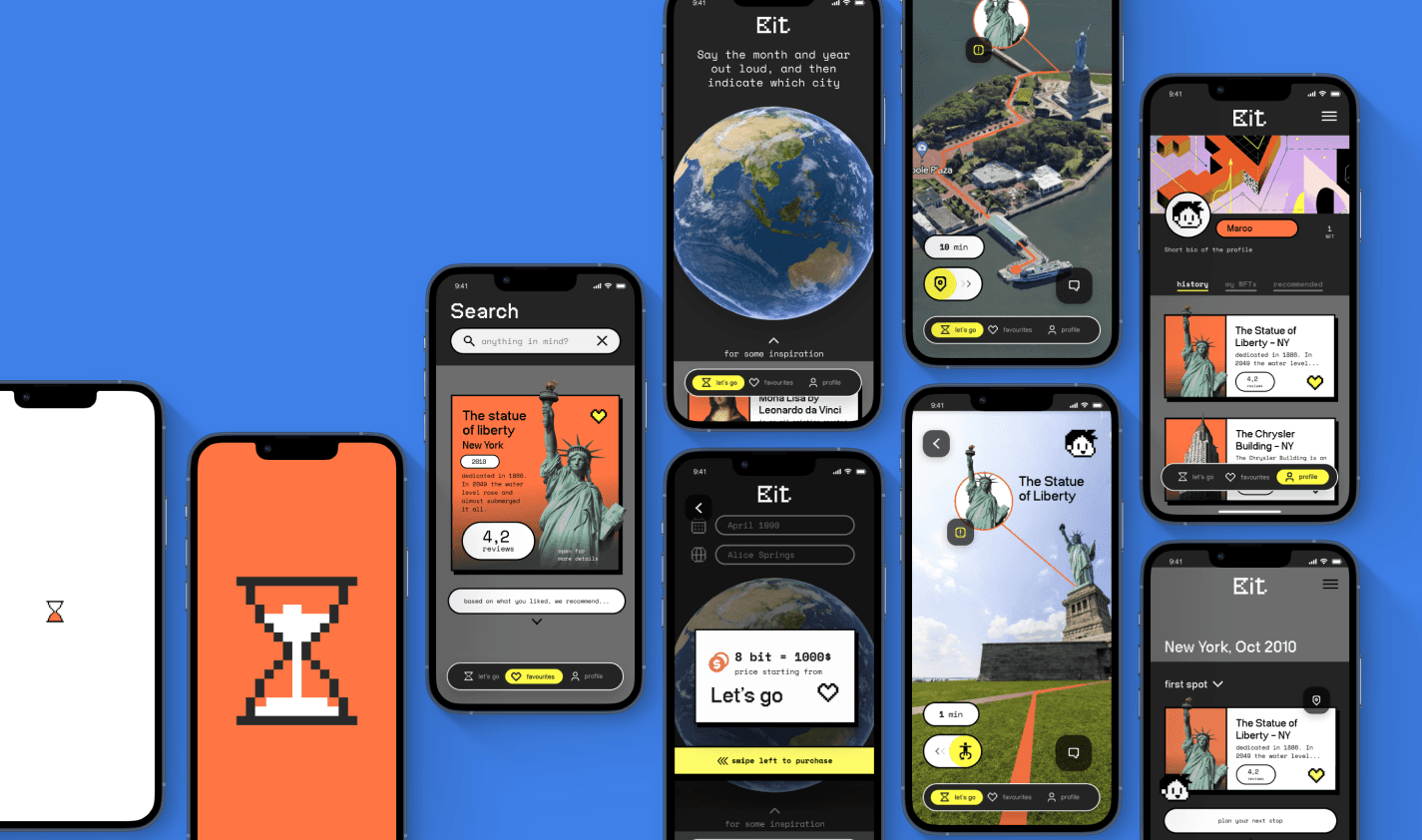

Result
This project was a journey into speculative design, where I learned to blend creativity with practicality, imagining not just a service but a whole new world. It reinforced the importance of thinking ahead, considering how design can respond to future challenges and opportunities. The experience deepened my understanding of user-centered design, especially in crafting experiences for scenarios that don’t yet exist.
The success of this project has inspired me to continue exploring speculative and future-focused design, applying these insights to create innovative solutions that anticipate the needs of tomorrow’s users. I’m excited to push the boundaries of what’s possible, turning visionary ideas into tangible, user-friendly designs.